
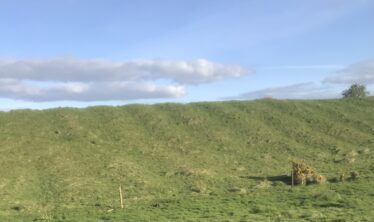
Potato ridges from the time of the famine still evident in Lakeview, Moylough (Photo John Whyte)
FAMINE STORIES
INTRODUCTION
180 years ago in 1846 the people of Moylough, like the rest of Ireland were in the throes of the Great Famine (An Gorta Mór).
Potato blight had first been seen in Ireland in Autumn 1845. As a consequence most of that year’s crop escaped blight. 1846 was a different story. The blight destroyed the Lumpers, the variety grown by the tenant farmers who had become dependent on potatoes and milk as the staples in their diet.
In their desperation for food the people had to find something else to eat. As well as eating turnips, cabbage, nettles they had to resort to wild roots and edible weeds.
Statistics present us with detached facts. The census returns of 1841 and 1851 reveal that the population of Moylough dropped by 29%, or from 7,248 to 5,149. The national population drop was less than 25%.
The Dúchas folklore collection paints a vivid picture of the struggle for food and survival in this as in every other area.
FOOD, FAMINE AND SURVIVAL
By the 1800s the potato had become the stable diet of the Irish peasant population. Adults and children ate potatoes for breakfast, dinner and evening meal. Adult labouring men could consume anything up to 14 pounds (over 6kg) of potatoes per day. Women and children would have eaten proportionally less. Potatoes are a source of carbohydrate, potassium, Vitamin C and fibre. Milk provides calcium, protein, fat, carbohydrates, and B vitamins. While a diet of milk and potatoes may have been bland, or sour if buttermilk was used, it would have provided the basic nutrients for a fairly healthy life. Meat would have been a rarity. Out of financial necessity eggs would have been sold more often than eaten. Cabbage, turnips, nettle, apples, blackberries and other wild fruits would have formed part of the diet.
Food was seasonal and cyclical. By late spring the Lumpers, the most common potato of the poor which was high a yielding variety, may have been inedible or rotted in the pits. Some families had not even enough land to sow sufficient potatoes to carry them through to the new crop in late July or early August. Milk was also another problem, especially if a family had only a cow or two. When the cow’s lactation period ends there is a gap of about three months before she calves and has milk again. Consequently, there were always ‘the hungry months’ when either milk or potatoes, or both were not available for some families. It is against this background that the successive failure of the potato crop in the 1840’s brought hunger, misery and disaster.
FOOD SCARCITY AND FAMINE
Food security in Europe itself much less Ireland is a modern concept. Over centuries disturbed weather patterns and/or wars contributed to major food scarcities and famines.
In the hundred years alone between 1740 and 1844 four severe food shortages were experienced in Ireland. 1740-41 is remembered in history as “Bliain an Áir’’ (the Year of Slaughter) when it is estimated that between 13% and 20% of a population of 2.4 million died from hunger. Scientists regard this famine as having been the result of climatic conditions consequent to the end of the Little Ice Age. Grain crops then formed a greater part of diet than did potatoes.
Forty years later in 1783, the eruption of the Laki volcano in Iceland and the consequent unseasonable weather conditions led to severe food shortages all over Ireland. This is reflected in correspondence between Sir Patrick Bellew in Louth and his cousin in Mountbellew; “we [in Louth] have terrible weather ……the poor are to be pitied greatly’’. Referring to the food riots in Moylough he continues: “Cassidy (Sir Patrick’s agent) writes me they are very riotous at Newtown Bellew (Moylough), some in great distress’’. (Chapel, Famine and Demesne Mountbellew 1822 page 90 Joe Clarke publ. 2022)
The 1816 eruption of Mount Tabor in Indonesia disturbed world weather systems causing the “year without a summer’’ in Ireland. Crops failed as a consequence. In a letter to Sir Patrick Bellew in Louth, Olivia Bellew of Mountbellew wrote: “the misery and distress of the poor is beyond conception …the oats good but potatoes and wheat quite bad, a very bad fever prevails on every side’’. (Chapel, Famine and Demesne Mountbellew 1822 page 91 Joe Clarke publ. 2022)
In 1821 and 1822 there was yet another food crisis. A volcanic eruption in Iceland wreaked havoc on the weather patterns, particularly along the Western seaboard. Excessively heavy August rains meant that both grain and potato crops suffered. By the end of 1821 there were reports of serious food shortages and suffering in the west of Ireland. In June 1822 Archbishop Trench reported “I passed through Moylough ….. I saw hundreds of starving people to whom the Clergyman of the Established Church and The Roman Catholic priest were distributing oatmeal’’. (Chapel, Famine and Demesne Mountbellew 1822 page 108 Joe Clarke publ. 2022)
So, before blight reached Ireland in the 1840’s the people were all too familiar with starvation.
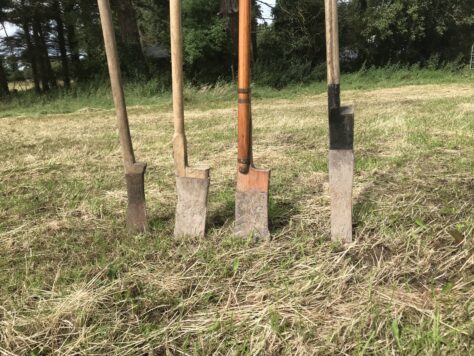
These are loys, implements that would have been used to dig the potato ridges before and during the famine. (Photo John Whyte).
HOW THE PEOPLE OF MOYLOUGH SURVIVED
All the stories below capture the struggle for survival in their essays for the Dúchas Collection Folklore collection.
“Is beag an cursios sa gceantar seo anois faoin Gorta Mór’’. (Very little is heard in this area about the famine], so wrote Michael Lyons. He made the point that it was only when he asked specific questions of his father (informant Michael Lyons) that he got any information. Micheal’s comment reflects the general silence on the Famine among the ordinary people in the years following the 1840’s.
As well as Michael, Josephine Healy (Lakeview, informant Michael Healy aged 65), Peggy Fleming (Springlawn, informant Mrs Quinn Springlawn aged 85), Eibhlin Ní Fathaig (Cooloo, informant Mrs Fahy) and Mary Quirke (Ballinruane, informant James Quirke aged 50) capture in their essays the struggle for survival during the famine. Josephine wrote that the “poor people ate ‘driosagáns’. They also ate water grass from the water’s edge. Government aid reached our district. Indian meal was distributed in the district.
Peggy Fleming described how “the people were seen gathering a sort of weed called ‘blosgáns’, then roasted in the fire and eaten’’. (Blasgáns and driosagáns are more than likely different pronunciations of the same plant, ie Silverweed).
Michael Lyons wrote “the famine was so bad that the people were delighted to get cutaway cabbage stalks and it was a common sight to see the people swallowing these, even though they were rotting. They also ate all kinds of plants even grass itself ”. By contrast some of the people of Cooloo fared better. Eibhlin wrote that “a particular landlord sowed 10 acres of parsnips for his employees’’.
Josephine tells us “the rich people had wine and biscuits’’.
Josephine also describes how the people changed their method of sowing the potatoes, “The next Spring [probably 1847] the people sowed the potatoes and they said the potatoes were not as big as ‘Múnógs’” (Múnóg is a cranberry found in bogs .
Sickness, as well as emigration, contributed to the decline in population. Both Josephine and Michael refer to the “sick house in Carrownacregg’’. This referred to Carrownacregg House which was used as a fever hospital at the time. Carrownacregg House – Skehana & District Heritage
Michael also says there was one in The Old Malthouse (Mountbellew).
With the level of hunger, starvation and disease caused by the famine inevitably came death and there are many reports of bodies lying on the side of the road. The following is from Willian Hans, informant Michael Fleming of Springlawn . “The roads around Mt Bellew were covered with corpses of the people. A person might be a week or a fortnight lying dead by a ditch before he would be buried because the neighbours or his people hadn’t strength enough to bury him”. He went on to say “There was a butcher in Mt Bellew in those days and he used to carry the corpses in his cart to Carrownacregg and throw them into a sand pit”.
Michael Lyons also reported a story of a watchman at one of the fever hospitals who had the job of burying the dead for which “he got a shilling from the government for every corpse he buried. When he had the dead all buried he started to bury those who were almost dead …….. buried them in the big graveyard outside the house even though it was clear that they were still alive”.
The above stories of starvation, survival and death from around Moylough are a microcosm for the whole country during that heartbreaking period in Ireland and sadly many more could be told.
Sources of Information:
Dúchas – Folklore data by Dúchas © National Folklore Collection, UCD and licensed under CC BY-NC 4.0.
Joe Clarke, “Chapel, Famine and Demesne Mountbellew 1822”, publ 2022
Skehana Heritage Society
Barry O’Sullivan, retired Mountbellew Agricultural College
No Comments
Add a comment about this page